

 WTCF on WeChat

 Official Weibo
 APP
APP

Publish Time:2026-03-23 15:56:38Source:WTCF
【Introduction】:On March 3 (Berlin time), the World Tourism Cities Federation (WTCF) was invited to attend ITB Berlin 2026, held in Berlin, Germany, where it released The World Tourism Economy Trends Report (2026) at the opening ceremony of the China Pavilion. The World Tourism Economy Trends Report(2026) represents one of the Federation’s flagship academic publications.
On March 3 (Berlin time), the World Tourism Cities Federation (WTCF) was invited to attend ITB Berlin 2026, held in Berlin, Germany, where it released The World Tourism Economy Trends Report (2026) at the opening ceremony of the China Pavilion. The World Tourism Economy Trends Report(2026) represents one of the Federation’s flagship academic publications. Since its first release in 2017, the report has been published consecutively for ten years. Each annual edition has attracted extensive attention from the global tourism industry. It serves as an important reference for tourism authorities and related institutions worldwide in assessing annual industry trends and formulating development strategies, and it enjoys strong professional credibility and international influence within the field of global tourism economics.
The report analyzes the global tourism economy from multiple dimensions, including the overall development environment, regional characteristics, and national performance. It systematically reviews the overall situation and structural features of the global tourism economy in 2025 and provides multi-scenario forecasts for global tourism growth in 2026. The report demonstrates strong forward-looking insight and significant value for industry decision-making.
The key findings are summarized as follows.
In 2025, the global economy showed signs of moderating growth accompanied by increasing regional divergence. The global economic growth rate declined from 3.3% in 2024 to 3.2% in 2025, and it is projected to further fall to 3.1% in 2026. Trade in services has become the most dynamic component of global trade, with digitally driven services demonstrating particularly strong performance.
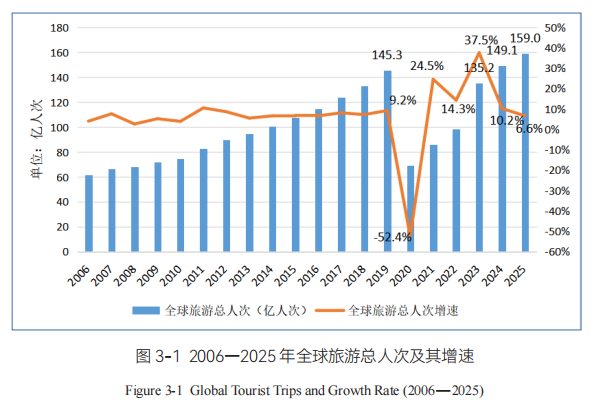
In 2025, the growth rates of global tourist trips and tourism revenue slowed significantly. Total global tourist trips reached 15.90 billion, representing a decline of 3.6 percentage points in growth compared with 2024. From a long-term perspective, global tourism trips have maintained a steady upward trend, although the sector remains sensitive to external shocks while demonstrating strong resilience.
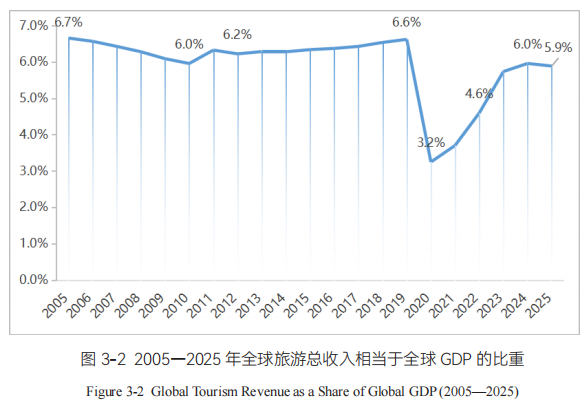
In 2025, the share of global tourism revenue in global GDP slightly declined. Global tourism revenue accounted for 5.9% of global GDP, representing a decrease of 0.1 percentage points compared with 2024.
The share of domestic tourism continued to rise in 2025. Global domestic tourist trips reached 14.41 billion, while global domestic tourism revenue amounted to USD 4.92 trillion.
For 2026, the report proposes three scenarios for global tourism development.
Pessimistic scenario: Geopolitical tensions escalate further, downside risks intensify, global economic growth underperforms expectations, and tourism development is adversely affected.
Baseline scenario: The global economy remains relatively stable, and governments introduce proactive policies to promote tourism development, resulting in steady growth in the global tourism economy.
Optimistic scenario: A new wave of technological revolution, improvements in the macroeconomic environment, and the growing role of emerging markets drive global economic growth. At the same time, countries adopt more remains relatively stable, and governments introduce proactive policies to promote tourism development, resulting in steady growth in the global tourism economy.
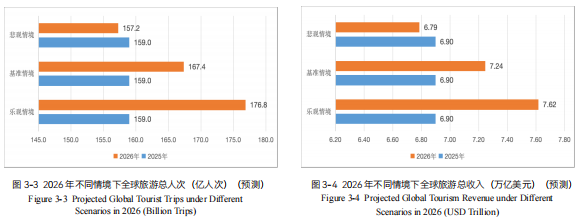
Overall, global tourist trips are expected to grow significantly in 2026. Under the optimistic scenario, global tourist trips will reach 17.68 billion, representing 11.2% year-on-year growth. Under the baseline scenario, global tourist trips will reach 16.74 billion, representing 5.3% growth. Under the pessimistic scenario, global tourist trips will reach 15.72 billion, representing a 1.1% decline.
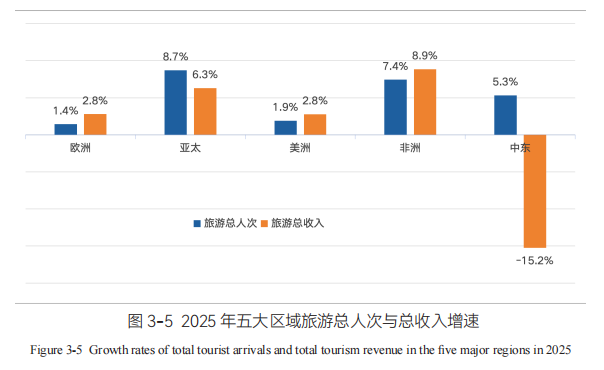
In 2025, the economic role of tourism varied significantly across the five major global regions. In Africa and the Asia-Pacific region, tourism industry growth exceeded GDP growth. Africa has become a core engine of economic growth, supported by high-value eco-adventure tourism and strong demand for high-end leisure vacations. The Asia-Pacific region acts as an accelerator of economic growth, supported by its large economic scale and rapidly increasing tourism flows. In Europe and the Americas, tourism growth rates remain broadly in line with regional GDP growth, positioning tourism as a stabilizer of economic development. Europe’s tourism sector, centered on cultural and business tourism, experiences relatively moderate growth due to inflation and rising labor costs. The Americas, benefiting from mature leisure and business tourism markets, maintain stable consumption structures and is less affected by exchange rate fluctuations and border policies. In the Middle East, tourism revenue represents the largest share of GDP, making tourism a pillar industry. However, due to geopolitical conflicts and the loss of high-end visitors, the growth of tourism revenue has not kept pace with GDP growth.
Looking ahead to 2026, tourism growth across the five regions is expected to continue diverging:
Asia-Pacific: 0.7%~11.5%
Africa: −2.7%~15.2% (largest volatility)
Middle East: −2.7%~11.7% (high elasticity and vulnerability)
Americas: −0.8%~9.6% (steady moderate growth)
Europe: −4.0%~8.7% (stable growth but under cost pressure)
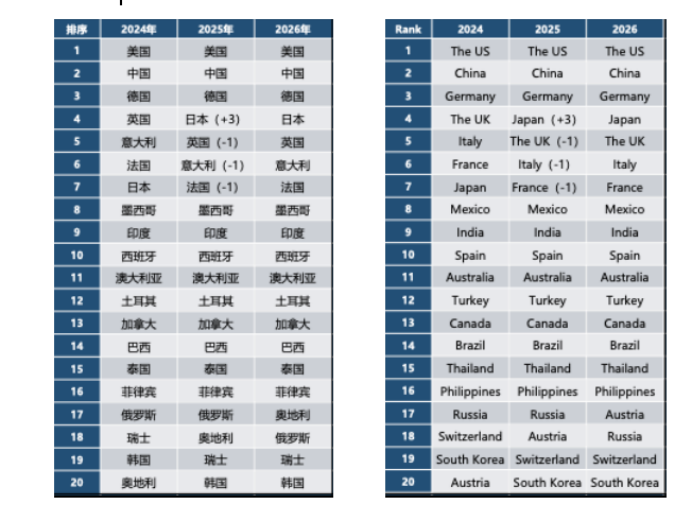
In 2025, the ranking of T20 tourism economies experiencs minor adjustments. The United States and China remain firmly in the top tier. Japan moves up three positions, driven by large-scale investment in cultural and tourism infrastructure. The United Kingdom, Italy, and France each drop one position. Most other countries maintain relatively stable rankings. The report expects the T20 rankings in 2026 to remain unchanged from 2025.
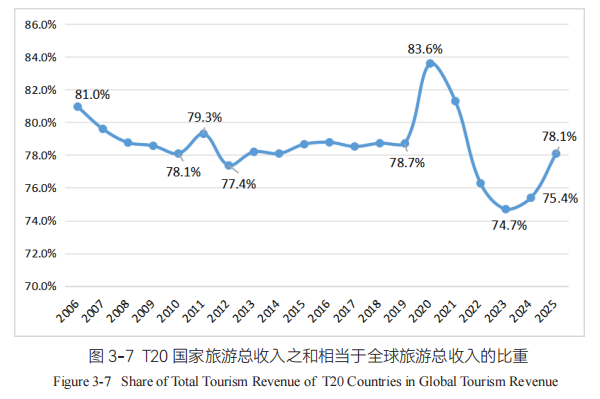
Tourism scale among T20 countries is highly concentrated, with significant divergence in growth rates. The combined tourism revenue of the United States and China accounts for 44.1% of the total among T20 countries. The combined tourism revenue of T20 countries represents 78.1% of global tourism revenue, showing a strong rebound. The share of international tourism revenue among T20 countries reached 62.9% of the global total, the second-highest level in the past 20 years.
The report identifies ten major development trends in urban tourism worldwide, covering nineteen casea across global cities, including seven cases from Beijing. The ten trends are:
(1)Immersive experiences—shifting from traditional sightseeing toward narrative-driven immersive tourism;
(2)Sustainable tourism—green and low-carbon development becoming a hallmark of international competitiveness;
(3)Night-time economy—expanding into multidimensional consumption ecosystems;
(4)Health and wellness tourism—forming new trends in medical and wellness travel;
(5)Technology-tourism integration—digital technologies reshaping the tourism industry ecosystem;
(6)Deep local exploration—growing demand for authentic and distinctive experiences;
(7)Precise market segmentation—systematic tourism product restructuring for different consumer groups;
(8)Inbound travel facilitation—creating seamless, “borderless” visitor experiences;
(9)Host-guest co-sharing—achieving harmonious coexistence between tourism development and residents’ quality of life;
(10)IP-driven experiential consumption —transforming cultural symbols into immersive tourism spaces;
The global tourism industry is entering a period of profound structural transformation.
(1)In the future, global tourism flows will no longer simply follow economic gradients (from developed to developing countries). Instead, they will increasingly shift toward regions characterized by stable policy expectations, secure governance environments, as well as open and inclusive international engagement.
(2)Developing countries with rich historical heritage and distinctive modernization pathways are reshaping global tourism aesthetics and travel culture by exporting unique cultural IP and tourism standards.
(3)Meanwhile, the integration of frontier technologies such as artificial intelligence (AI), low-altitude economy, and quantum computing is fostering new productive forces within the tourism industry.
(4)Purely resource-dependent tourism models will gradually become unsustainable. Future competitiveness will depend on the ability to extract the spiritual essence of local culture and transform it into emotionally resonant tourism experiences.
(5)The boundaries between tourism, residence, work, and everyday life are increasingly dissolving. Tourism cities that can provide high-quality public services, inclusive community environments, and sound legal frameworks will attract global talent and consumption power, achieving a qualitative leap in urban functions.


E-Mail Login|Contact Us|Careers|Legal disclaimer
世界旅游城市联合会版权所有 备案号:京ICP备19050424号-1
Our legal counselors: Beijing Jincheng Tongda & Neal Law Firm